


If you’re a civil servant in Zimbabwe, and one day you receive an SMS from G-Tide that you never subscribing for, you’re going to wonder how they got your number. Here’s how: A friend of yours gave it to G-Tide. And they did that for a chance to win a US $85 mobile phone.
We learnt of this G-Tide promotion last week when we posted an Econet eTXT article on our Facebook page. A reader commented: “Unlike gtide zimbabwe’s competition at least we dont have to sell our friend’s cellphone numbers in order to win something. great innovation Econet”.
We checked the G-Tide Facebook page. Here’s a screenshot of the promotion announcement:
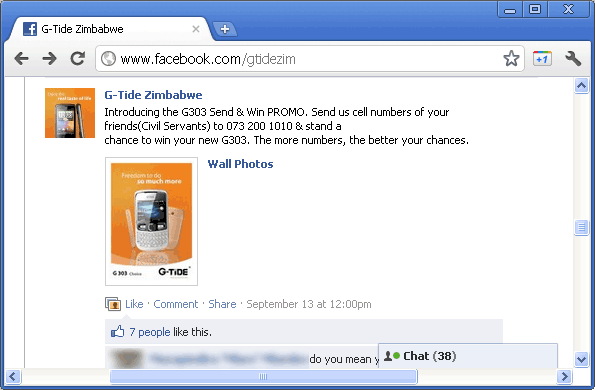
That’s all there is to it: Give G-Tide as many civil servant friends’ phone numbers as you can and stand a chance to win a mobile phone. Nothing about why they need these phone numbers. Nothing about what they will do with the phone numbers. Nothing about how they will protect owners of the phone numbers from unsolicited commercial SMS messages and cold calls.
We sent a message to G-Tide with questions about how long the promo is running, what they plan to do with the numbers and a comment on the ethical line. The following is part of the response we received from the G-Tide Zimbabwe Head of Communications, Alpha Tereki:
..the promo is running from now till end of september.. the numbers and emails will basically be used for our database and CRM… we want to foster a stronger relationship with our customers.. it’s very ethical.
we will ask the person [whose number has been submitted] if they would like to receive G-Tide info etc.. if they say no, then we will not contact them at all
A local blog, 3-Mob, had an article about this sort of thing last week. The summary of the article is that it is against Zimbabwean law to spam people with telephone messages.
G-Tide Zimbabwe has had quite some commercial success locally. The brand is associated with improving access to mobile telephony for the bulk of the 7 million mobile phone subscribers in Zimbabwe in Zimbabwe. G-Tide came along with low cost Asian feature phones at a time when a lot of people could not afford the more expensive brands like Nokia, Samsung, HTC, BlackBerry and iPhone.
The company not only provided cheaper alternatives, most times it provided imitations of the expensive brands. You could for example buy a BlackBerry lookalike for just US $50 where a genuine BlackBerry costs at least 10 times that.
This playing-close-to-the-line strategy has worked well for G-Tide. In fact, G-Tide has catered for a market largely ignored by the established brands; ordinary people that just want more features on an inexpensive mobile phone.
But there is a line. And there is world of difference between playing close to it and just unashamedly crossing it.
 Share
Share Home
Home
29 comments
A bit ridiculous isn’t it? Someone needs to keep track of this.
How appalling. They really have no ethics. This is illegal and has to be stopped. I would advise any civil servant who is annoyed to keep the messages for any possible class action suites. This is worth taking to the mainstream press
This is unethical, but I think it’s a stretch to call it illegal. Can someone point me in the general direction of the law being broken?
I do not condone this, but the law is severely lacking (not just in Zimbabwe, BTW, but in the region). Cold-calling marketers are annoying, but until there’s a law that implements a ‘do-not-call registry’ a-la USA.
In the absence of laws, the best we can do is call out & shame people who do this.
what then happens in the case that such information is stolen, it can cause unforeseen damage to both individual and national security, technology can be dangerous u know
For sure, this type of behaviour should not be allowed.
All this is happening whilst POTRAZ big boys are picking there noses under the table of ignorance! We need a POTRAZ which is very techwise with very long sharp tooth to bite or byte!
small world. they’ll hear about it, rest assured.
hope so soon!
I beg to differ, they said friends’ & they also said they kept a record of who sent which number should any clarification be requested by those who will have received a promotional SMS.
you have to consent to your personal information being shared…friend or foe. What would your thoughts be if I shared your work place/home address just because I know you. The friend is wrong and GTide even moreso because it is the one soliciting.
That’s why they can point you to your friend. Look, all i’m saying is let’s not always be on the pessimistic edge, i’m a developer & i’m well in the field. I know the challenges. Potraz won’t give local wap developers licenses like they did mobitones among a whole host of other issues because we simply don’t believe in good coming from ourselves.
For a change let’s say “WHY NOT: & not “WHY”
is it because you do not pay palm sweetening money? l understand you!
u are not being forced to be on the database.i believe as far as business is concerned these guys should be given credit because they have catered for a market that wish to own expensive phones but cannot afford.am really impressed by their consistence in business and the passion to expand their customer service.come to think of it you can never compare them to Swav/G-Mobile mobile as these guys reap people of their cash and they do not even have any consistence in product and service delivery.i say keep it up and am really impressed.well done Gwatidzo and Shumba.u guys are the best in this game.
this has nothing to do with their business, how well they have catered the market, how you are impressed by them and their passion to expand customer service.
neither is it about a comparison with their competition, its consistency and lack of service delivery or how you are so impressed and feel they are the best in the game.
that is well and fine.
__________________________________________
The ISSUE HERE IS: they are requesting people to disclose people’s numbers without consent. That is ILLEGAL. And doing it for Government employees sounds like taking a drop of cyanide…just to taste it.
If you truly value them, you would request them to change strategy, because I can assure you that the legal recourse can be epic. This violates many laws.
Country’s biggest workforce, contributing $10 each for a class action = rich lawyer plus bankrupt Gwatidzo and Shumba.
Surely you cant cheer your friends into a pit of snakes.
Well spoken.
zvako iwe enock!!! ma sms were sent to other civil servants to expand their market,,dnt let these journalists bring u down without adequate information,,,simple-its business anhuwe…hu was there for u wen u culdnt afford blackberry yacho???maguta manje
Espionage at best! Civil servants some of them work in very sensitive areas of government, why only civil servants numbers they are interested in?
ln addition to POTRAZ, l encourage our security services to have a closer look at this and get some people for questioning.
This is national security there are muddling in, who is the “behind the scene people or gvt” who wants that information and for what?
What are they going to use that database for after they have created it? Who is going to benefit from such a project?
Somebody have to answer these questions and more.
because they are the only ones for which Government & bank institutions permit get phones on credit without too much hustle on the retailers’ part
lm not convinced, then whaat are they going to use it for?
From a developer point of view it make much sense to have a database of numbers etc, so that your service(or watever) can be accessed by a lot of people, But the problem is why ask my friend to give you my number, why not ask me to give you my number?(because most likely i will not) these guys are trying to cheat their way into collecting ours numbers, its just not ethical
If anything, this empasizes the need for organisations/service providers to be registered with some association(s) e.g. COMSA, CSZ, ZISPA etc. Those associations enforce & educate ethics that all members would subscribe to and provide avenues for recourse or dispute resolution.
what is COMSA and CSZ?
COMSA: CoMputer Suppliers Association
CSZ: Computer Society of Zimbabwe – http://www.csz.org.zw/
I just realised I am in that database and their text messages annoy me..
what is the text message saying if you dont mind me asking?
this is unethical someone should sue the pants off them,have they no shame
why are the g-tide guys not even contributing to this post???
I hate GTIDE phone with a passion
Gtide should apply for an SMS platform from the service providers and advertise their promotion simply stating …
“sms register to **** to quqlify for entry into ****competition and stand a chance to win $***…” chete.
they are showing lack of creativity and initiative as an entity. This way registration is voluntary. Further still terms and conditions must apply. Tell the people what will happen to their numbers and where the liabilities stand in the event of breach of security of their data base. Give the consumer the option… don’t open yourselves up to legal battles.