



POTRAZ just dropped the Q2 2025 sector report, and buried in the tables is a story we’ve been expecting: Starlink is here, and the numbers show the continued shake-up it’s brought to the market.
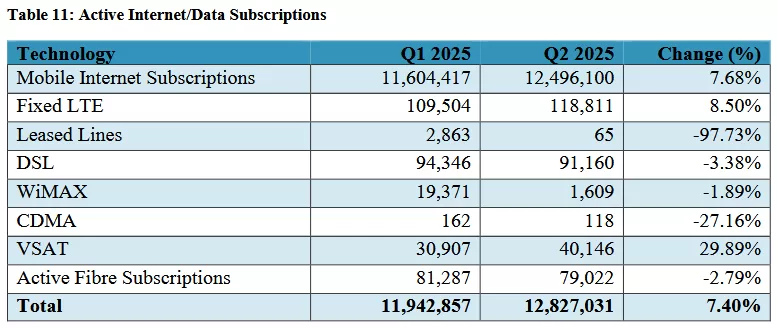
VSAT subscriptions, that’s the category Starlink falls under, jumped by almost 30% in one quarter. We’re now at just over 40,000 active terminals.
Active VSAT subscriptions increased from 30,907 in the first quarter of 2025 to 40,146 in the second quarter of 2025.
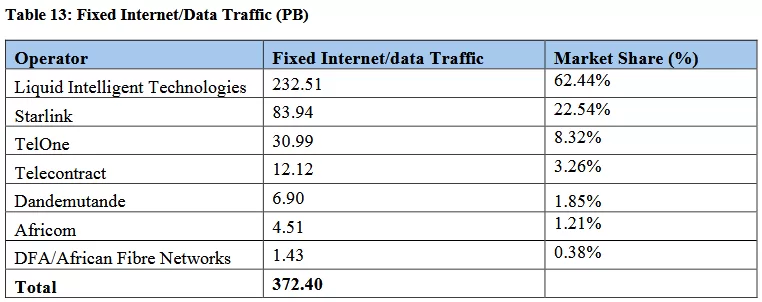
It doesn’t sound mind-blowing until you see what those 40k users are doing: they chewed through 83.9 petabytes of data, nearly a quarter of all the country’s fixed internet traffic.
Yes, Starlink has already taken 22.5% of the market in terms of data moved. Only Liquid is ahead.
Starlink held the second largest share of fixed Internet/data traffic, following Liquid Intelligent Technologies (62.44%) and TelOne (8.32%).
And while those dishes were pulling in TikToks, Netflix and whatever else Zimbos do online, leased lines pretty much collapsed.
POTRAZ says we went from almost 3,000 leased line subscriptions to 65. It doesn’t get any worse than that, and the crazy thing is that one wonders why those 65 are still holding on.
The scary bit is that active fibre subscriptions fell by almost the same number, in absolute numbers, going from 81,287 in Q1 to 79,022 in Q2. That’s a 2.79% decline, and I think Starlink and other relatively new fixed internet products in the market are to blame.
Why this is happening
Starlink is not cheap, but compared to what Zimbos have had to deal with? It’s a deal. For businesses that were on leased lines, the maths is brutal:
- Starlink hardware hurts upfront, but after that it’s a flat monthly fee (plus the US$5 regulator levy, of course, Mthuli needs his piece).
- No waiting months for installation. You just buy the kit, plug it in, and that’s it, you’re online.
- Speeds are good, coverage is everywhere (when capacity allows), and for the first time, you can actually stream or back up large files without going up a tree.
Why would anyone stick with a leased line that’s slower, capped, and more expensive?
This isn’t just about price either. It’s about convenience and reliability. A farm in Karoi, an NGO in Lupane, even a shop in Gumbonzvanzva, they can all just get online now without begging an ISP to trench fibre.
The winners and losers
- Winners: Urban households that can afford the kit, SMEs that just want reliable internet, and yes, the multitude of TikTok creators who no longer have to drive around Harare hunting for upload speeds.
- Losers: Leased line providers. POTRAZ didn’t sugar-coat it. That whole business is done.
Companies selling fibre to the home still have an edge where they actually have coverage. But outside that, every customer who can sacrifice and pay the Starlink fee is a customer they might never get back.
A regulator still figuring things out
Here’s a funny line from POTRAZ: they excluded Starlink from their “used international bandwidth” chart because they haven’t worked out how to account for it yet.
This means the regulator knows people are using Starlink, but they don’t yet know how to fit it neatly into the old boxes.
It’s understandable; this isn’t your usual undersea cable + Internet Service Provider kind of deal. Starlink is a foreign-owned group of satellites that beams internet directly to Zim households.
Our international bandwidth accounting and even tax collection models weren’t built with that in mind. Hence why Mthuli introduced that regulatory charge we talked about.
Not for everyone
Let’s be clear: Starlink is not suddenly connecting every villager in Gokwe. The kit costs real money, and that alone keeps it out of reach for most.
The early adopters are businesses, NGOs, and wealthier households. However, it’s encouraging to see our government deploying kits to schools and Rural District Councils and beyond.
So, as more dishes come in and as people join up or resell capacity in creative Zimbo ways, expect Starlink’s footprint to grow.
And the impact is already huge: 40,000 subscribers using nearly a quarter of the country’s fixed internet capacity is impressive.
What we’ll be watching
- Will Q3 numbers show Starlink eating even more of the pie?
- Do companies like Liquid or TelOne fight back with lower prices or new bundles?
- How will POTRAZ eventually count and tax Starlink traffic?
We shall see, but for now, let’s marvel at how ridiculous this Starlink story is.
In just one quarter, Starlink did what most new ISPs can’t do in years. It killed leased lines and took a fat slice of Zimbabwe’s internet traffic. If this is the starting point, the next few reports are going to be very interesting.






Comments
11 responses
To be honest, this isn’t just a market shift, it’s natural selection but with Wi-Fi signals. For years, our local ISPs have been selling us bandwidth like it’s caviar, delivered it on donkey carts, then priced like it was blessed by Nehanda naKaguvi🤣. The reality is sticking to these providers nhasi, in 2025, is like insisting on a fax machine isu tane WhatsApp.
Zvikaramba zvakadaiso Elon will orbit these companies into extinction. The worst case is they don’t adapt or even believe in change, look at what Econet did👺.
EXACTLY!
💯
Attributing the 22.5% market share solely to competitive displacement overlooks the nuanced reality. Providers such as TelOne, Dandemutande, Frampol, and Aura are not merely passive participants—they are actively championing Starlink’s integration. Therefore, framing its expansion as detrimental to these entities is misleading, given their instrumental role in its proliferation. Moreover, the narrative of market erosion for incumbents like TelOne, Liquid, or Utande fails to account for the evolving usage patterns: Starlink is increasingly adopted as a redundancy solution, complementing rather than replacing existing infrastructure.
On the contrary, it’s the legacy providers that are being used as redundancy. Despite initial scepticism about reliability, many companies have adopted Starlink as the primary Internet connection and have the downgraded legacy connections as backup, or merged into the same network.
Outside of Harare, Starlink outright replaced legacy providers in many instances.
Absolutely 💯
Zvimwe hazvidi nharo. Just get Starlink zvipere.
I would like to know how POTRAZ knows how much traffic is going via Starlink????
Starlink likely gives them the figures as part of their reporting.
The only sad thing is Starlink hasn’t yet managed to wipe out market share of these straight up evil and unscrupulous providers in Harare. Econet straight up throttled me to 1mbps after I paid $87.
Ndakambotengawo re87 ichiri smartbiz speed kana kuchinja kodofambira nyaya dzacho pacustomer care zvose nekushop kana chakabuda kusvika raexpire haa ma1